Bathroom Vanity Cabinets for Budget Hotels and Hostels: Durable Low-Cost Specifications That Hold Up
When vanity budgets are tight, the smartest savings come from simplifying design, not from weakening the parts that meet water every day. This guide shows which specification choices to keep and which to simplify.
A budget hotel vanity cabinet does not have to be a weak one. The units that hold up in economy hotels and hostels are usually not the cheapest on paper; they are the ones where money is spent on moisture protection and hardware, and saved on shape, finish and variety. This guide sorts specification choices into those you should protect and those you can safely simplify.
The principle: cut complexity, not water resistance
A vanity fails where water, cleaning chemicals and daily knocks meet the cabinet. Everything else is mainly appearance. When you reduce cost, take it from design complexity first and from material performance last.
In economy hotel FF&E, the bathroom vanity is a small item per room but is multiplied by every room. A saving of a few details per unit becomes meaningful across a whole building, so it pays to decide carefully where to save.
Specifications worth keeping
1. Moisture-resistant carcass material
Standard interior-grade particleboard or MDF swells once water reaches an unsealed edge or the base. For wet bathrooms, choose a moisture-resistant board, or a board with a water-repellent facing such as HPL or good-quality melamine, and keep the base area protected. Where the budget allows only one upgrade, make it this one.
2. Sealed edges, especially at the bottom and around the basin
Edge banding is not decoration. Well-bonded PVC or ABS edging on all exposed edges, plus sealing of cut-outs for the basin and taps, prevents most early swelling. Ask your supplier how cut-out edges are treated, because this detail is often missing from low quotations.
3. Reliable hinges and runners
Doors and drawers are opened many times a day. Use commercial-grade hinges and runners with a suitable load rating, and corrosion-resistant finishes in humid rooms. Soft-close is optional; sturdy fixings are not.
4. A raised base or plinth detail
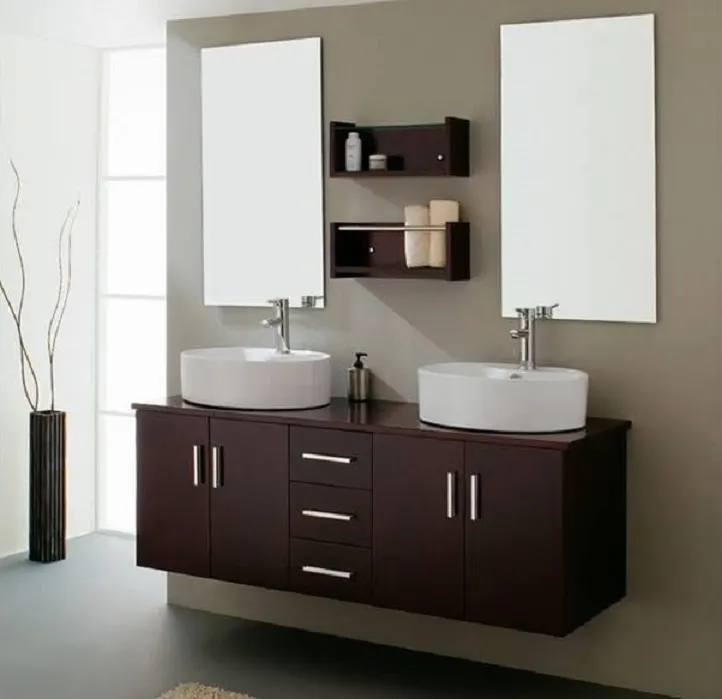
Mops and splashes hit the lowest part of a floor-standing unit. A moisture-resistant plinth, or a wall-hung design with a clear gap beneath, keeps the carcass out of standing water and makes cleaning quicker.
5. Proper wall fixing
Loose units rattle and damage silicone joints. Specify fixing rails or brackets suited to the wall type, and check that the wall has suitable backing before installation.
Specifications you can simplify
1. Door and front style
Flat fronts are easier to produce and easier to clean than framed, fluted or shaker-style fronts. A plain front in a durable laminate or HPL is often the best value choice for economy hotels.
2. Finishes
Painted or lacquered finishes need more process steps and show chips more clearly. Laminate or melamine in a wood-effect or solid colour is more forgiving and easier to replace or touch up.
3. Number of variants
Every extra size or layout adds drawings, set-ups and ordering risk. Try to reduce the range to one or two vanity widths across room types. Standardisation is often the largest single saving available.
4. Integrated storage
Hair dryer holders, amenity trays and pull-outs add cost and parts that can fail. In a budget property, an open shelf or a simple single drawer is often enough for guests.
5. Lighting and mirror integration
Built-in LED lighting and smart features need electrical coordination and extra components. A plain mirror fixed to the wall, with separate lighting, is simpler to maintain and replace.
Decision table: keep, simplify or review
| Item | Recommendation | Reason |
|---|---|---|
| Carcass board | Keep moisture-resistant | Prevents swelling at the base and edges |
| Edge banding and cut-out sealing | Keep | Most water damage starts here |
| Hinges and runners | Keep commercial grade | Frequent use and humidity |
| Door style | Simplify to flat fronts | Lower production cost, easier cleaning |
| Finish | Simplify to laminate or HPL | Durable and easy to replace |
| Number of sizes | Simplify | Fewer drawings and fewer ordering errors |
| Soft-close, pull-outs, LED | Review per project | Nice to have, not essential for durability |
Hostels: a few extra points
Hostel bathrooms may be shared and used by many more people per day than hotel rooms. Consider the following:
- Robust, repairable parts such as standard hinges and drawer runners that a local maintenance team can replace.
- Rounded or protected corners where luggage and cleaning equipment pass.
- Simple open or wipe-clean surfaces that do not trap moisture or dirt.
- Multi-basin counters in a single material rather than many separate units, if the layout allows.
Choose the top and basin carefully
A solid surface, laminate or sealed composite top is usually more economical than natural stone and performs well in busy bathrooms. Ceramic basins are widely available and easy to replace. Whatever you choose, confirm basin cut-out dimensions and tap positions in the drawings before production, because rework is expensive.
Where low quotations hide extra cost
Two quotations for the same unit can differ because of what is left out. When you compare, check for:
- Board type and thickness of the carcass and back panel.
- Edge banding type and whether all edges are covered.
- Hardware specification, not just the brand name.
- Packing method and corner protection for export.
- Whether tops, basins and mirrors are included or supplied separately.
Cost also depends on quantity, destination, shipping terms such as EXW, FOB or DAP, and the approval process, so a fair comparison needs the same scope on both sides.
Approve one sample before the full order
Even for simple units, a single sample or mock-up bathroom is a low-cost way to check dimensions, door swing, tap position and finish. Changes at this stage are small; the same changes after production starts are not. It is also the moment to confirm that a simplified design still works for housekeeping.
Conclusion
For economy properties, a durable and affordable vanity comes from a clear rule: protect the water-exposed parts and simplify everything else. Moisture-resistant boards, sealed edges, sound hardware and good fixing do most of the work, while flat fronts, fewer variants and plain finishes keep the budget under control.
If you are planning an economy hotel or hostel, send us your bathroom drawings or room schedule. We will review the vanity requirements and suggest a specification that fits your budget, quantity and destination.
Sıkça Sorulan Sorular
What is the most important feature in a budget hotel vanity cabinet?
Moisture protection matters most. A moisture-resistant carcass, well-sealed edges and a protected base prevent the swelling and peeling that cause early replacement. Appearance upgrades can be simplified, but the parts that meet water every day should keep a proper specification.
Can laminate or HPL work for economy hotel vanities?
Yes. Good-quality laminate or HPL is durable, easy to clean and available in many colours. It performs well when edges are properly banded and cut-outs are sealed. Poor edge detailing, not the surface itself, is the usual cause of failure.
How can I reduce vanity costs without lowering quality?
Reduce the number of sizes and variants, choose flat fronts and plain finishes, and skip extras such as integrated lighting or pull-outs. Keep moisture-resistant boards, sealed edges and sound hardware. Standardising across room types is often the biggest saving.
Are hostel bathroom vanities different from hotel ones?
The construction is similar, but hostels often need more robust, easily repairable units because of heavy shared use. Standard hinges and runners, protected corners and wipe-clean surfaces help. Multi-basin counters may suit shared bathrooms better than several small units.
Do I need a sample before ordering budget vanity cabinets?
A sample or mock-up is strongly advisable, even for simple units. It lets you check dimensions, tap positions, door swing and finish at low cost. Fixing mistakes on one unit is far cheaper than correcting a full production run.
Every hotel project is different. Send us your drawings or room schedule for a tailored proposal on materials, lead time and shipping.