Anatolian Timber Alchemy: Advanced Manufacturing, Wood Chemistry, and Global Trade Dynamics of Distressed Solid Wood TV Units in Turkey
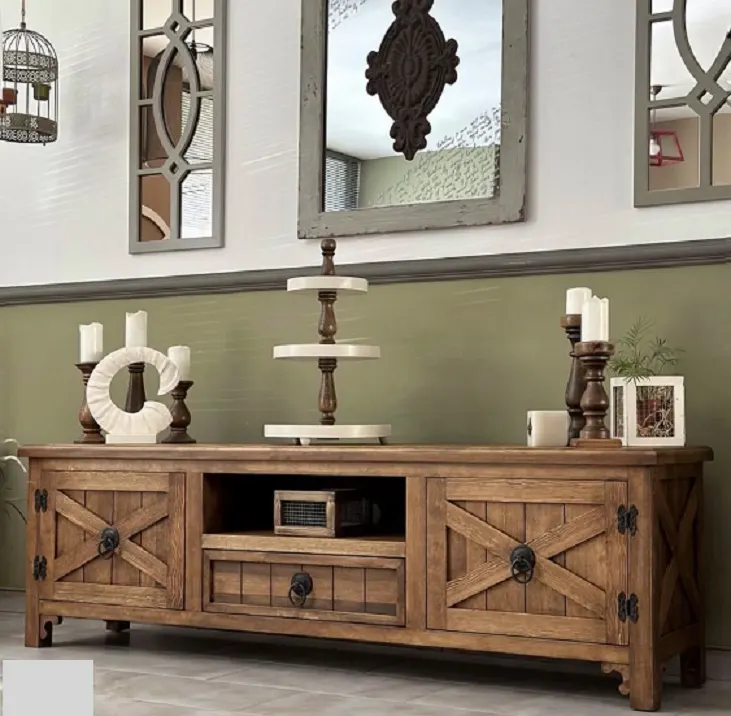
Behind every heirloom-grade distressed solid wood media console exported from Turkey lies a sophisticated marriage of forestry science, wood metallurgy, industrial thermodynamics, and cross-border customs engineering. While casual observers see only rustic charm—hand-scraped edges, weathered gray patinas, wire-brushed oak valleys, and wrought-iron hardware—seasoned furniture engineers and international trade specialists recognize an intricate industrial choreography.
Exploring this technical ecosystem in full depth is the mission of Anatolian Timber Alchemy: Advanced Manufacturing, Wood Chemistry, and Global Trade Dynamics of Distressed Solid Wood TV Units in Turkey.
Turkey’s rise to the upper echelons of global casegoods manufacturing has been fueled by its ability to convert both domestic Anatolian hardwoods and imported North American and European lumber into high-margin, design-forward furniture. Specifically, distressed solid wood TV units represent one of the highest-performing SKUs in Turkey’s export portfolio, bridging the gap between artisanal luxury and scalable industrial production. By examining the molecular mechanics of tannin reactions, the physics of kiln-drying equilibrium, the financial leverage of Turkey’s Inward Processing Regime (Dahilde İşleme Rejimi), and the strict compliance architectures of EUDR and ASTM standards, Anatolian Timber Alchemy: Advanced Manufacturing, Wood Chemistry, and Global Trade Dynamics of Distressed Solid Wood TV Units in Turkey provides an authoritative blueprint for manufacturers, wood technologists, and global trade executives.
1. Wood Anatomy and Timber Metallurgy in Turkish Media Console Production
Creating an authentic distressed solid wood TV unit begins at the cellular level of the timber. Unlike conventional high-gloss or uniform satin furniture—where wood is sanded glass-smooth to mask its anatomical structure—distressed woodworking deliberately exploits the differential hardness between a tree’s earlywood (springwood) and latewood (summerwood), as well as its ray cells and natural extractives.
Ring-Porous vs. Diffuse-Porous Species Selection
Turkish furniture engineers select timber species based on how their vascular structures respond to mechanical abrasion and chemical staining:
• Ring-Porous Hardwoods (Anatolian Chestnut, American White Oak, European Oak, Ash): In ring-porous species, large-diameter vessels are concentrated in the earlywood formed during spring, while dense, thick-walled fibers dominate the latewood formed in summer. When passed through rotating steel or abrasive nylon (Tynex) wire-brushing heads, the soft earlywood vessels are excavated to a depth of 0.5 mm to 1.8 mm, leaving the dense latewood ridges standing proud. This creates a deeply tactile, undulating surface that traps pigmented glazes and cerusing waxes.
• Diffuse-Porous Hardwoods (Turkish Steamed Beech, Anatolian Walnut): Diffuse-porous woods feature evenly distributed, small-diameter pores across the entire growth ring. Because wire-brushing produces a much subtler texture on beech or walnut, Turkish craftsmen rely on percussive mechanical distressing—hand-planing with curved-sole gouges, skip-planing, chain-beating, and cross-grain band-saw kerfing—to sculpt surface relief before applying multi-step patinas.
• Coniferous Softwoods (Siberian Larch, Scandinavian Red Pine): Softwoods exhibit dramatic density contrasts between resinous latewood bands and porous earlywood. Turkish factories in Kayseri and İzmir utilize high-speed rotary brushing on kiln-dried larch and pine to create pronounced "driftwood" and "reclaimed barn wood" textures, subsequently hardening the surface with high-solids 2K polyurethane sealers to resist indentation during residential use.
Extractives and Natural Tannin Content
In Anatolian Timber Alchemy: Advanced Manufacturing, Wood Chemistry, and Global Trade Dynamics of Distressed Solid Wood TV Units in Turkey, wood chemistry is just as vital as mechanical milling. Hardwood heartwood contains complex polyphenolic compounds known as hydrolyzable and condensed tannins:
• Anatolian Chestnut (Castanea sativa): Contains exceptionally high concentrations of ellagitannins and castalagin (often 8% to 12% by dry weight). This makes Turkish chestnut uniquely reactive to alkaline and metallic mordants, allowing finishers to achieve deep charcoal, weathered silver, and antique bronze tones without relying on opaque surface paints.
• White Oak (Quercus alba & Quercus robur): Rich in gallic and ellagic acids, oak reacts predictably to ammonia fuming and iron-acetate solutions, producing authentic centuries-old European castle patinas.
2. Thermodynamics of Kiln Drying and Structural Stability Engineering
A solid wood TV unit is subjected to punishing mechanical and environmental stresses. It must support heavy, concentrated loads (often 50 to 80 kg of television and audio equipment) across wide horizontal spans (160 cm to 260 cm) while surviving extreme hygrothermal swings during ocean container transit and seasonal indoor heating cycles.
Psychrometrics and Equilibrium Moisture Content (EMC)
Wood is a hygroscopic polymer matrix composed of cellulose, hemicellulose, and lignin. Water exists within green timber in two states: free water inside cell lumens and bound water hydrogen-bonded to hydroxyl groups within cell walls. Once free water evaporates, the wood reaches its Fiber Saturation Point (FSP)—typically around 28% to 30% Moisture Content (MC). Below the FSP, any loss or gain of bound water causes dimensional shrinkage or swelling:
• Tangential Shrinkage (parallel to growth rings): 7% to 10% from green to oven-dry.
• Radial Shrinkage (perpendicular to growth rings): 4% to 6% from green to oven-dry.
• Longitudinal Shrinkage (along the grain): Negligible (0.1% to 0.3%).
Because tangential shrinkage is roughly double radial shrinkage, flat-sawn boards naturally tend to cup away from the pith as they dry. Leading Turkish manufacturers in İnegöl and Bursa eliminate this failure mode through rigorous kiln-drying protocols:
1. Multi-Zone Vacuum and Conventional Steam Kilns: Computer-controlled kilns continuously monitor wet-bulb and dry-bulb temperatures alongside automated pin sensors embedded deep within sample boards.
2. Target Moisture Calibration: Lumber destined for North American or Central European TV units is dried to 7.5% ± 0.5% MC. Lumber destined for Middle Eastern or Mediterranean markets is calibrated to 9.5% ± 0.5% MC.
3. Equalization and Stress-Relief Conditioning: During the final 24 to 48 hours of the kiln cycle, relative humidity inside the chamber is elevated briefly via steam injection. This equalizes the moisture gradient between the drier outer shell and slightly damper core of each plank, relieving internal "case-hardening" stresses so boards do not bow or pinch saw blades during ripping.
Stave Lamination Geometry and Joinery Mechanics
To build a warp-free 45 mm thick distressed solid wood top, Turkish engineers follow strict lamination rules:
• Stave Width Ratio: Individual staves are ripped to widths between 50 mm and 85 mm. Keeping stave width under twice the board thickness drastically minimizes cupping torque.
• Growth Ring Alternation: Staves are arranged with alternating bark-side up and bark-side down orientations so residual transverse stresses cancel one another out across the panel width.
• Structural Reinforcement: For wide-span media consoles, factories mill two parallel 12 mm × 25 mm dados into the underside of the solid wood top and bolt heavy-duty galvanized steel C-channels into place using oversized slotted holes. This steel skeleton prevents creep deflection under heavy televisions while permitting unrestricted cross-grain seasonal expansion.
3. Artisanal Distressing Metallurgy and Surface Finishing Chemistry
What elevates Anatolian Timber Alchemy: Advanced Manufacturing, Wood Chemistry, and Global Trade Dynamics of Distressed Solid Wood TV Units in Turkey above generic mass-market furniture is the sophisticated multi-stage surface alchemy performed in Turkish finishing departments. Rather than applying a single coat of tinted lacquer—which looks flat and plastic—Turkish master finishers build optical depth through sequential chemical and physical layers.
Stage 1: Mechanical Sculpting and Edge Aging
Before a drop of liquid touches the timber, panels undergo a calibrated sequence of physical aging:
• Cross-Grain Kerfing & Skip-Planing: Band-saw blades with set teeth are lightly grazed across portions of the panel to leave authentic 19th-century sawmill marks.
• Rotary Wire Brushing: Panels pass beneath twin counter-rotating drums fitted with 80-grit and 120-grit abrasive nylon bristles, excavating soft earlywood while burnishing dense latewood ridges.
• Hand-Applied Impact & Edge Wear: Artisans use custom-forged iron hammers, heavy link chains, and hand rasps to break sharp machine-milled arrises, creating organic dents, irregular corner chamfers, and clustered woodworm pinholes. Crucially, surfaces are then lightly orbital-sanded with 180-grit abrasive sponges so impact craters feel smooth and burnished by decades of touch.
Stage 2: Chemical Mordants and Fuming Reactions
To achieve authentic aged patinas that penetrate deep into the wood fibers rather than sitting on top, Turkish chemists utilize reactive treatments:
• Iron Acetate Mordant (Ebonizing / Weathering Solution): Iron filings or steel wool dissolved in acetic acid (vinegar) react directly with gallic and tannic acids inside oak and chestnut. Within minutes of application, the wood undergoes an oxidative color shift from pale tan to weathered driftwood gray, slate blue, or deep charcoal—highlighting natural tannin variations across heartwood and sapwood.
• Ammonia Fuming (Fumed Oak): Placed inside sealed polyethylene tents or pressurized chambers, solid oak TV unit carcasses are exposed to anhydrous ammonia vapor. The ammonia reacts with natural tannins to produce rich, warm, translucent tobacco-brown and espresso hues throughout the top 2–3 mm of wood fiber, completely free of synthetic dyes.
• Potassium Dichromate & Alkaline Bleaching: For warm antique amber tones or pale Scandinavian coastal finishes, controlled two-part hydrogen peroxide/sodium hydroxide bleaches strip natural lignins before neutralization with dilute citric or acetic acid.
Stage 3: Multi-Layer Glazing, Cerusing, and Topcoat Protection
Once chemical base tones cure and stabilize, finishers apply a five-step protective system:
1. NGR (Non-Grain Raising) Dye Base: A fast-drying solvent or water-reducible dye establishes uniform underlying warmth.
2. Wash Coat (Tie Coat): A low-solids (8–10%) vinyl or polyurethane barrier coat seals the wood pores partially, preventing the subsequent glaze from muddying the flat surfaces.
3. Wiping Glaze / Antique Patina: A slow-drying, pigment-rich glaze (raw umber, burnt sienna, or lamp black) is sprayed across the entire console and hand-wiped with cheesecloth and scouring pads. The glaze clears off the raised latewood ridges while remaining locked inside wire-brushed valleys, wormholes, and chamfered corners—creating dramatic three-dimensional contrast.
4. Cerusing Paste (Optional): For modern organic or coastal SKUs, pigmented white or pearl-gray liming wax is worked perpendicular to the grain into open oak pores and wiped clean.
5. High-Durability Protective Topcoat: Finally, automated Cefla reciprocating spray lines apply two coats of 2K (two-component) Acrylic Polyurethane or Waterborne Urethane-Acrylic at a dead-matte sheen (5 to 12 gloss units). These crosslinked polymers provide superior resistance against water rings, alcohol spills, UV yellowing, and abrasion while meeting strict EU REACH and US EPA TSCA Title VI low-VOC indoor air quality mandates.
4. Import-Export Trade Architecture and Customs Optimization in Turkey
Understanding the commercial engine behind Anatolian Timber Alchemy: Advanced Manufacturing, Wood Chemistry, and Global Trade Dynamics of Distressed Solid Wood TV Units in Turkey requires analyzing how Turkish factories import raw timber and export finished furniture under favorable customs regimes.
Raw Timber Import Flows into Turkey
Because Turkey’s domestic forestry harvests (regulated tightly by the General Directorate of Forestry, Orman Genel Müdürlüğü - OGM) cannot single-handedly supply the booming export sector, Turkey is a major net importer of high-grade temperate hardwoods and softwoods:
• North American Hardwoods: Rough-sawn kiln-dried American White Oak, Red Oak, Ash, and Black Walnut arrive via container vessels into Mersin, Gemlik, and Ambarlı ports from US East Coast ports (Norfolk, Savannah, Charleston).
• European & Black Sea Timber: European Oak, Beech, and Hornbeam are imported via road and short-sea vessels from Romania, Croatia, France, and Ukraine, while Siberian Larch and Scots Pine enter Black Sea ports such as Samsun and Trabzon.
• Customs & Phytosanitary Clearance: Imported sawn lumber (HS Code 4407) undergoes mandatory agricultural inspection (Zirai Karantina) at Turkish ports of entry to verify valid Phytosanitary Certificates and ISPM-15 heat-treatment compliance.
Leveraging the Inward Processing Regime (Dahilde İşleme Rejimi - DİR)
One of Turkey’s greatest competitive weapons in global furniture manufacturing is the Inward Processing Regime (DİR) administered by the Turkish Ministry of Trade:
• Duty & VAT Suspension: Under a DİR authorization certificate (Dahilde İşleme İzin Belgesi - DİİB), a Turkish furniture exporter imports American White Oak lumber or European hardware (Blum/Hettich drawer slides) 100% exempt from import customs duties, Resource Utilization Support Fund (KKDF) levies, and 20% Value Added Tax (KDV).
• Export Commitment & Yield Ratios: In exchange, the manufacturer commits to processing those imported raw materials into finished distressed solid wood TV units (HS Code 9403.60) and exporting them within a specified window (typically 6 to 12 months). Customs authorities audit standard industrial waste/yield ratios (accounting for kerf loss, planing shavings, and knot trimming during distressed milling).
• Landed-Cost Advantage: By eliminating upfront import taxes on raw lumber and hardware, Turkish manufacturers preserve working capital and pass direct cost savings on to international B2B buyers.
Export Tariff Advantages: A.TR, EUR.1, and MFN Status
When finished distressed solid wood TV units depart Turkey, bilateral trade agreements grant buyers major tariff advantages:
• European Union (0% Duty via A.TR): Even when a Turkish TV unit is crafted from imported American White Oak, the substantial transformation undergone during kiln-milling, joinery, distressing, and finishing confers Turkish Customs Union status. Accompanied by a validated A.TR Movement Certificate, the unit enters Germany, France, the Netherlands, Spain, and all other EU states at 0% import duty.
• United Kingdom & EFTA (0% Duty via EUR.1): Under the UK-Turkey FTA and EFTA-Turkey FTA, qualifying wooden furniture enters tariff-free.
• United States (0% MFN Rate & Section 301 Immunity): Unlike Chinese wooden furniture burdened by 25% Section 301 tariffs, Turkish living room furniture classified under HTSUS 9403.60.8081 enters the United States at the standard Most Favored Nation (MFN) rate of 0% (Free).
5. Navigating EUDR, CITES, and Global Regulatory Compliance
In the mid-2020s, regulatory compliance has become the decisive barrier to entry in international timber trade. Within Anatolian Timber Alchemy: Advanced Manufacturing, Wood Chemistry, and Global Trade Dynamics of Distressed Solid Wood TV Units in Turkey, institutional compliance separates tier-one export factories from domestic workshops.
EU Deforestation Regulation (EUDR) Traceability Mechanics
Regulation (EU) 2023/1115 mandates strict due diligence for all wood products placed on or exported from the European Union market:
• Polygon Geolocation Mapping: Turkish manufacturers must maintain digital supply-chain ledgers linking every batch of finished TV units back to the exact GPS polygon coordinates of the forest parcels where the trees were felled—whether in Kastamonu (Turkey), West Virginia (USA), or Slavonia (Croatia).
• Deforestation-Free Cutoff: Verifiable satellite and forestry authority records must confirm that the harvest plots experienced zero deforestation or forest degradation after December 31, 2020.
• Batch Segregation: Export-certified Turkish factories physically segregate EUDR-compliant and FSC® Chain-of-Custody lumber in dedicated warehouse bays using barcode batch tracking from rough mill to final carton labeling.
CITES and Lacey Act Compliance (North America)
For exports to the United States and Canada:
• US Lacey Act Declaration (PPQ Form 505): Importers must file a formal Lacey Act plant and wood product declaration specifying the exact scientific genus and species (e.g., Quercus alba or Castanea sativa), country of harvest, quantity, and value.
• CITES Verification: While temperate oak, chestnut, beech, and pine are non-CITES species, factories incorporating exotic tropical accents (such as reclaimed teak or rosewood inlays) must provide valid CITES export/re-export permits.
Structural Safety and Tip-Over Prevention (ASTM F2057 & EN 14749)
Because large-screen televisions pose severe tip-over hazards if mounted or placed on unstable consoles, Turkish export engineers design media units to satisfy rigorous mechanical standards:
• Center-of-Gravity & Open-Drawer Stability: Cabinets are weighted and proportioned so they remain stable even when all drawers are simultaneously fully extended and loaded.
• Mandatory Anti-Tip Restraint Kits: Every export carton includes a heavy-duty woven steel cable restraint kit with wall toggle anchors and illustrated installation warnings compliant with ASTM F2057 and EN 14749.
6. Precision Packaging Engineering and Intermodal Freight Economics
A hand-distressed solid wood TV unit is both heavy (50–95 kg) and geometrically vulnerable at its corners and overhanging top edges. Protecting that craftsmanship across thousands of kilometers of ocean and road transit requires engineered packaging systems.
ISTA-3A Compliant Export Carton Architecture
Leading Turkish exporters operate internal packaging testing labs or partner with accredited testing centers to validate packaging against ISTA (International Safe Transit Association) 2A and 3A protocols:
1. Zero-Abrasion Surface Wrap: Units are wrapped in 2 mm closed-cell polyethylene micro-foam sheeting. Tape is never allowed to contact finished wood surfaces directly.
2. High-Density Edge & Corner Buffering: Molded EPS foam blocks (density ≥ 22 kg/m³) or die-cut multi-layer corrugated honeycomb pads (minimum 30 mm thickness) isolate the cabinet from exterior impacts on all six faces.
3. Heavy-Duty 5-Ply BC-Flute Cartons: Exterior boxes are constructed from virgin kraft double-wall corrugated board rated at 275–350 lbs bursting strength, reinforced with automated heat-sealed polypropylene strapping.
4. Hygroscopic Container Protection: During sea transit across fluctuating thermal zones (e.g., transiting the Mediterranean and North Atlantic in winter), warm humid air inside a shipping container condenses on the cold steel ceiling—a phenomenon known as "container rain." Turkish loaders hang 1.5 kg to 2 kg calcium chloride desiccant poles along container walls and place silica gel packs inside every carton to maintain interior container relative humidity below 50%.
Volumetric Efficiency: Setup vs. Semi-Knock-Down (SKD)
To optimize freight economics per unit in a 40' High Cube (40' HC) container (~68 CBM usable capacity):
• Fully Assembled (Setup) Carcass + Detachable Base: Rather than shipping a 180 × 45 × 60 cm TV unit with legs attached (0.49 CBM), Turkish engineers design bolt-on solid wood or powder-coated steel bases that pack neatly inside the cabinet’s interior shelving cavity or flat against the back panel. This reduces packed height by 15–18 cm, lowering unit volume to ~0.38 CBM and boosting container capacity from ~135 units to 170+ units per 40' HC—slashing per-unit ocean freight costs by over 20%.
7. Quality Assurance Metrics and Defect Prevention in Distressed Wood
Quality control in distressed furniture presents a unique philosophical challenge: how do you distinguish intentional artisanal distressing from genuine manufacturing defects? Within Anatolian Timber Alchemy: Advanced Manufacturing, Wood Chemistry, and Global Trade Dynamics of Distressed Solid Wood TV Units in Turkey, factories establish objective, measurable boundary tolerances.
Intentional Character vs. Rejectable Defects
Feature Attribute Acceptable Artisanal Distressing (Pass) Rejectable Manufacturing Defect (Fail)
Surface Splits & Checks Shallow, stabilized seasoning checks (< 1.5 mm wide, < 100 mm long) sealed completely with topcoat Open structural splits penetrating through board thickness or running along glue joints
Knots Tight, intergrown sound knots or black knots filled flush with dark epoxy resin Loose, falling-out dead knots or open voids exposing raw unsealed wood
Dents & Hammer Marks Smoothly sanded, glazed impact marks aligned with the Golden Sample aesthetic Sharp, raw-wood splinters or accidental forklift/handling gouges breaking the finish film
Color Variation Organic tonal variation within the approved 3-panel Control Color Range Board Blotchy uneven stain pooling, un-wiped glaze streaks, or mismatched door/drawer fronts
Flatness & Joinery Diagonal corner wobble ≤ 1.5 mm on calibrated flat surface; tight miter seams Open glue lines (> 0.2 mm), cupped tabletop (> 2 mm across 45 cm), or binding drawers
Third-Party AQL Inspection Protocols
International buyers enforce ANSI/ASQ Z1.4 Level II sampling during Final Random Inspections (FRI) prior to balance payment:
• Critical Defects (AQL 0): Structural instability, sharp protruding nails/staples, active wood-boring insects, wet timber (> 11% MC), or missing anti-tip hardware.
• Major Defects (AQL 1.5): Cracked panels, non-functioning soft-close slides, color tones outside the approved Control Range Board, or crushed carton corners.
• Minor Defects (AQL 4.0): Slight glue squeeze-out inside hidden cabinet corners or minor underside finish roughness.
8. Market Trajectory and Future Technological Horizons
As global interior design pivots further toward biophilic, tactile, and sustainable living spaces, the future of Anatolian Timber Alchemy: Advanced Manufacturing, Wood Chemistry, and Global Trade Dynamics of Distressed Solid Wood TV Units in Turkey is being shaped by three converging innovations:
1. Zero-VOC Bio-Based Finishing Systems: Turkish chemical suppliers and furniture factories are rapidly transitioning from solvent-borne polyurethanes to plant-derived hardwax oils, UV-cured bio-acrylates, and zero-VOC waterborne ceramic-reinforced topcoats, delivering ultra-matte natural wood feel alongside commercial-grade stain resistance.
2. Digital Twin Prototyping & AI Grain Matching: Leading İnegöl and Istanbul design studios now utilize high-resolution 3D surface scanning to create photorealistic digital twins of distressed finishes. International retail buyers can approve wire-brush depth, knot density, and cerusing contrast virtually before physical timber is cut—compressing product development cycles from eight weeks to ten days.
3. Reclaimed Anatolian Timber Certification: Driven by circular-economy mandates in Western Europe, specialized Turkish timber yards are salvaging structural oak and pine beams from dismantled 19th-century Anatolian granaries, tobacco barns, and railway infrastructure. Kiln-sterilized, metal-detected, and precision-milled into modern media consoles, these certified reclaimed units command top-tier retail price points across London, Paris, New York, and Dubai.
Frequently Asked Questions (FAQ)
Why is Anatolian Chestnut considered one of the best woods for distressed TV units in Turkey?
Anatolian Chestnut (Castanea sativa) possesses a dramatic, coarse ring-porous grain similar to oak, exceptional dimensional stability, and an unusually high natural tannin content (8–12%). This allows Turkish finishers to create deep, authentic aged patinas using natural chemical reactions rather than heavy artificial paints, while offering superior resistance to decay and warping.
How does Turkey’s Inward Processing Regime (DİR) benefit international furniture buyers?
The DİR program allows Turkish furniture manufacturers to import raw timber (such as American White Oak) and European hardware (such as Blum drawer slides) completely free of customs duties and 20% VAT, provided the finished TV units are exported. This lowers raw material financing costs by 15–25%, enabling Turkish factories to offer highly competitive FOB pricing.
What moisture content level should be specified for solid wood TV units exported from Turkey to the USA or Europe?
Buyers should contractually mandate a core timber moisture content of 7% to 9% verified via calibrated pin-type and pinless moisture meters prior to assembly and shipment. This matches the indoor Equilibrium Moisture Content of climate-controlled homes in North America and Europe, preventing shrinkage cracks during winter heating seasons.
Are Turkish distressed solid wood TV units compliant with EU Deforestation Regulation (EUDR) rules?
Yes, tier-one Turkish export factories maintain full chain-of-custody documentation—including GPS polygon geolocation coordinates of timber harvest plots and post-2020 deforestation-free verification—for both domestic OGM-certified hardwoods and imported North American/European lumber, ensuring seamless customs clearance into the European Union.